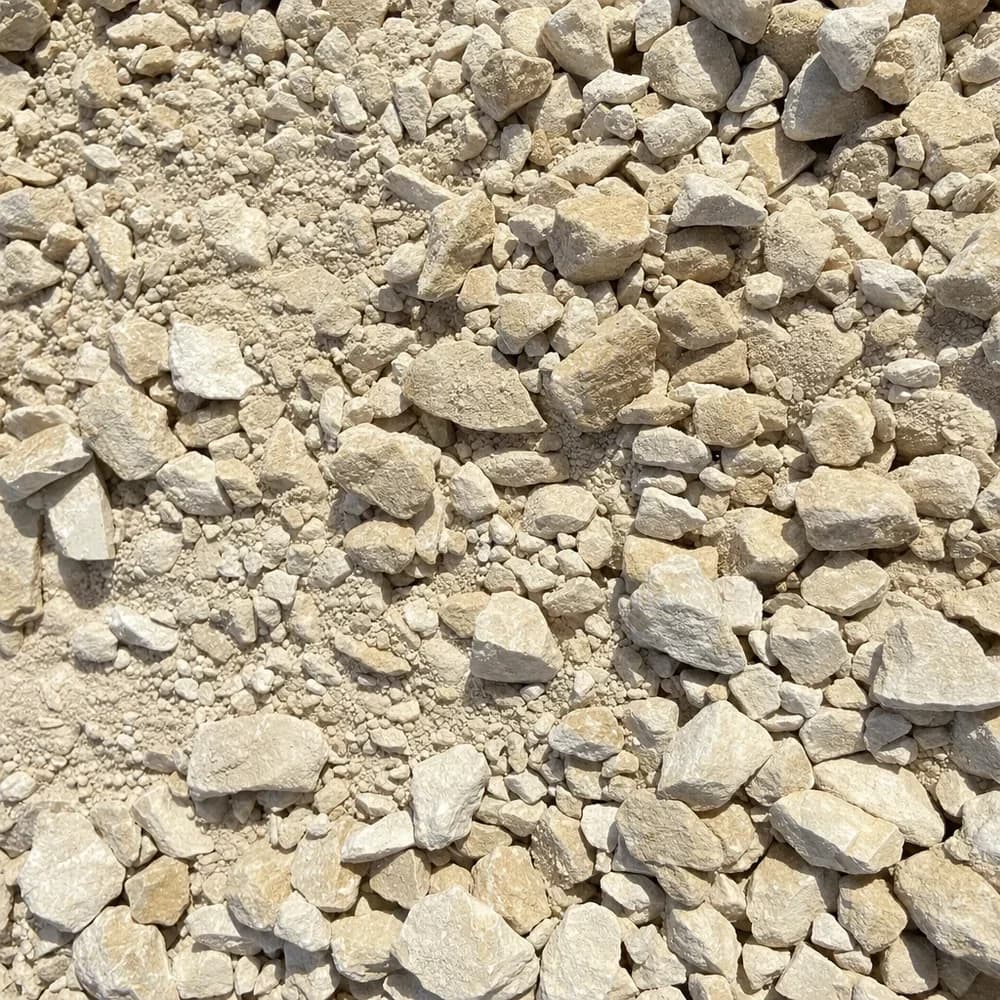
Crusher Run Calculator for a Lane Built Over Flatwoods Sand
Enter your project dimensions
Peel the sod off a flatwoods lot and the first spade of ground is loose gray sand that drains in minutes and carries almost nothing under a wheel. Bridging that is the whole job of a compacted base, and this crusher run calculator is the stage of it that tells you how many tons the lane in front of you will actually swallow. Work through the job in the order it happens and the number you put in the depth box will be the right one.
Digging out the root mat before any depth is decided
Nothing gets measured until the organic layer is off. Strip the sod and the dark, rooty sand beneath it, because that material keeps breaking down and settling long after the rock has been rolled. On a flatwoods lot you may hit a firm hardpan a foot or two down that holds water above it after a storm, and in a low corner you may find soft muck that has to come out entirely rather than be covered over.
None of that changes the arithmetic. It changes the depth you choose and how much spoil you haul away. When you get to the tool, enter the thickness of the rock layer, not the depth of the hole you dug for it.
Setting the rolled thickness a lane is going to be driven on
Enter the finished compacted thickness. Loose base stands proud of its final height, so a layer bought for its loose depth finishes low once the plate compactor has been over it.
Four inches after compaction suits paths and the structural layer under pavers. Four to six covers a car drive. Six to eight is the range for a lane a delivery truck, a boat trailer or a loaded pickup will turn on. Over freshly stripped sand, take the depth up rather than hoping the roller finds firmness that is not there. Depth moves your tonnage more than any other field, which is why the tool accepts anything from a quarter inch to 24 inches instead of guessing on your behalf.
Feeding a 65 by 11 lane into the crusher run calculator
Pick a shape first. Rectangle asks for length and width in feet. Circle asks for one diameter in feet. Multiple areas lets you build the job out of as many as five separate pieces, which is how a straight run plus a turnaround apron gets added up in one pass. Depth is always in inches. The material select decides the weight behind the tons line, and a checkbox, ticked by default, adds 10 percent extra for compaction and spillage and can be unticked. Press calculate and the results box returns cubic yards, tons and cubic feet, with the option of having the figure emailed to you.
Here is a hypothetical run, done longhand so you can follow it.
A lane 65 feet long and 11 feet wide is 715 square feet. At 5 inches compacted, 715 x 5 = 3,575, divided by 12 gives 297.9 cubic feet. Divide by 27 and that is 11.03 cubic yards. Crusher run is published on this site at roughly 3,000 lb a cubic yard, or 1.50 tons, so 11.03 x 1.50 comes to 16.6 tons. With the 10 percent box ticked, the figures move to about 12.13 cubic yards and 18.3 tons. Eighteen and a half tons is a sensible order.
Ordering the base and the driving course as two separate lines
Crusher run is the layer that carries the load, not the layer you look at. Most drives take a top course over it. Two inches of #57 Limestone across that same 715 square feet works out at 715 x 2 = 1,430, divided by 12 is 119.2 cubic feet, divided by 27 is 4.41 cubic yards. At about 2,800 lb a yard, or 1.40 tons, that is 6.18 tons, or 6.80 with the allowance ticked. Run the calculator twice and order the two lines separately rather than averaging them.
If the base product in your cart is Limerock Base rather than Crusher Run, the tonnage comes out identical, since both are published here at 1.50 tons a cubic yard. Use the limerock base calculator for that one so the material select matches what you are buying.
There is one place this material does not belong. The fines are the reason it locks up under a wheel, and they are also the reason it holds water. Keep it out of a French drain and away from backfill against a perforated pipe. Where water has to move, size clean washed stone on the stone calculator instead.
Spreading two lifts between afternoon storms
Split a 5-inch layer into two passes of roughly two and a half inches and compact each one. A single deep pour packs hard on top and stays loose underneath, which shows up as ruts by the second summer. Damp material binds better than dry, so a light misting ahead of the compactor helps. Saturated material will not compact at all, which is the argument for booking the work either side of a rainy-season afternoon rather than during one.
Keep a wheelbarrow load back. Sand moves under heavy rain, and the low spot that appears along an edge after the first tropical downpour is cheap to fix while the material is still on site.
Cubic feet, cubic yards and the 3,000 pounds under each one
The three numbers in the results box describe one pile. Cubic feet is raw volume: your footprint in square feet times the depth in inches, divided by 12. Cubic yards divides that by 27, because a cubic yard is a block three feet on every side and bulk rock is sold and hauled by the yard. Tons converts the volume to weight using the published figure for whichever material you picked.
That last step is why the same depth of two materials arrives as different tonnage. Crusher run runs around 3,000 lb a cubic yard because its fines sit in the gaps between the larger pieces. Clean #57 leaves those gaps open and comes in near 2,800 lb. Both figures are approximate, light after a dry week and heavy after a wet one, but the volume you ordered has not changed.
When the tonnage looks right, open the product page to choose a quantity and a delivery date, or send your measurements through the contact page and ask before you commit to a depth.
Common questions
My drive runs straight and then opens into a turnaround. Can I do both at once?
Yes. Choose Multiple areas, enter the straight run as one rectangle and the turnaround as another, and keep the two footprints from overlapping where they meet. Set one depth for both if they carry the same traffic. You can add up to five pieces, so an apron at the road and a parking spur can go into the same calculation.
The lane will have a paver or timber edge. Do I measure to it or past it?
Carry the base past it. An edge only stays put if it sits on compacted rock instead of sand, so add six inches beyond each open side and enter that larger footprint. On a 65 by 11 lane edged along both long sides, that turns 715 square feet into 780, which is worth about a ton and a half at 5 inches.
How do I split one order between the base and the rock that shows on top?
Run the tool twice on the same footprint, once at the compacted base depth and once at the two or three inch surface depth, changing the material select each time so the weight matches. Order both lines together and have them dropped as separate piles, base nearest the work.
My parking spot is a rough oval, not a rectangle. What do I enter?
Draw the smallest rectangle that contains it and enter that, or split it into two or three rectangles under Multiple areas and accept a little overlap at the corners. Rounding a curved edge outward costs you a fraction of a ton and saves you a second delivery.
The lane already has rock on it and only needs topping up. How deep is that?
Push a rod or a long screwdriver through the existing surface in several places to find how much sound material is there, then enter only the difference you want to add. Anything under about two inches will not hold on its own, so if the old base measures thin in patches, scarify it and top up to a full compacted depth rather than skimming.
Related calculators
Base tonnage sorted? Good.
Crusher run by the ton, the cheapest structure on the yard, delivered free.