Road Base Calculator for a Limerock Lane Across Soft Sand
Enter your project dimensions
A lane across a sandy back lot carries nothing until you put something under it that does. That is the whole reason this road base calculator exists: to turn a length, a width and a finished thickness into the tonnage of limerock that will bridge ground which drains in minutes and then rolls under a tire. The page below follows one hypothetical job, a 90-foot lane from the drive back to a pole barn, in the order the work actually happens.
Standing on the run after a July storm, before any tape comes out
Walk the route the day after a heavy afternoon downpour, because that is when the lot tells you the truth. The spots still holding water an hour later are the spots that will pump and rut under a loaded truck, and they set the depth for the whole run rather than for their own few feet.
Strip the sod and the dark rooty sand under it before you settle on a number. On a flatwoods lot you may find a hardpan a foot or two down holding water above itself, and in a low corner soft organic muck that has to come out rather than be buried. None of that changes the sum. It changes the thickness you choose and how much spoil leaves the property.
Four inches finished suits light residential use on ground that is already firm and drained. Six is the working figure for a lane a delivery truck or a loaded trailer uses. Eight to twelve belongs under equipment, a container or anywhere the subgrade stays soft. Florida base material is specified by FDOT by material type and tested with the Limerock Bearing Ratio, which is how a written specification names it locally rather than anything this storefront certifies. If your job carries one, build to the specified compacted thickness and not to a figure off a page.
Staking the width the wheels use, and the flare at the road
Run the length along the center of the lane rather than down one edge, and take an average width if the run narrows through a gate and opens again at the barn. Shoulders that get grass rather than rock stay out of the width entirely.
Stake the flare where the lane meets the drive separately. It is short, it is wider than the lane, and it is the piece people leave out and then come up short on.
Ninety feet of lane and a flare, typed into the road base calculator
Rectangle takes a length and a width in feet, circle takes a single diameter for a turning apron, and multiple areas totals up to five pieces in one pass. Depth goes in as inches, anywhere from a quarter inch to 24, and one depth covers the whole run. The material line sets the weight behind the tons reading, a checkbox, ticked by default, adds 10 percent for compaction and spillage and can be unticked, and the panel returns cubic yards, tons and cubic feet together, with the option of emailing the figure to yourself.
The lane is 90 by 10 feet, or 900 square feet. The flare at the road is 14 by 12, another 168. Both finish at 6 inches, so they go in as two areas in one run: 1,068 square feet total. 1,068 x 6 = 6,408, divided by 12 is 534 cubic feet, divided by 27 gives 19.78 cubic yards. Limerock base is published on this site at roughly 3,000 lb a cubic yard, or 1.50 tons, so that is 29.67 tons. With the 10 percent ticked, the panel reads about 21.76 yards and 32.64 tons.
Enter the thickness you want left when the roller is finished. Loose material stands proud of its final height, so a layer bought at its loose depth finishes thin.
Rolling four inches at a time so the sand underneath stays put
Place it in lifts no deeper than about four inches and compact each one before the next goes on. A single deep dump packs on top and stays loose underneath, which shows up as ruts in the second wet season. Damp material binds; saturated material does not compact at all, which is the argument for booking the spreading into a dry stretch rather than the middle of a rainy-season afternoon.
Crown the surface so water leaves at the sides instead of standing on the center line. On a flat lot that fall is the difference between a lane that sheds a downpour and one that softens under it. Twenty to thirty tons is a week of hand work and an afternoon with a box blade, so plan the machine before the delivery date, and take two drop points along the run rather than one heap at the entrance.
Adding the driving course as its own line, not as extra depth
The limerock is the layer that carries the load. Most drives take a thinner course over it for looks and for keeping fines off shoes and tires. Size it as a second run rather than adding inches to the first, because the weight behind it is different.
Two inches of #57 Limestone over the same 1,068 square feet works out at 1,068 x 2 = 2,136, divided by 12 is 178 cubic feet, divided by 27 is 6.59 cubic yards. At about 2,800 lb a yard, or 1.40 tons, that comes to 9.23 tons, or 10.15 with the allowance ticked. Two lines on the order, two piles on site, and neither one averaged into the other.
There is a second listing that behaves the same on the scales. Crusher Run is also published at 1.50 tons a cubic yard, so the tonnage is identical, but the two are not interchangeable in use: the base product carries a larger top stone for load, while the finer mix grades to a smoother finish for close paver work. If that is what is going in your cart, run the numbers on the crusher run calculator so the material line matches the listing.
Where the three figures come from, and the 3,000 pounds behind the tons
Cubic feet is your footprint in square feet times the depth in inches, divided by 12. Cubic yards divides that by 27, because a cubic yard is a three-foot cube and bulk material is hauled by the yard. Tons applies the published weight of whatever the material line is set to.
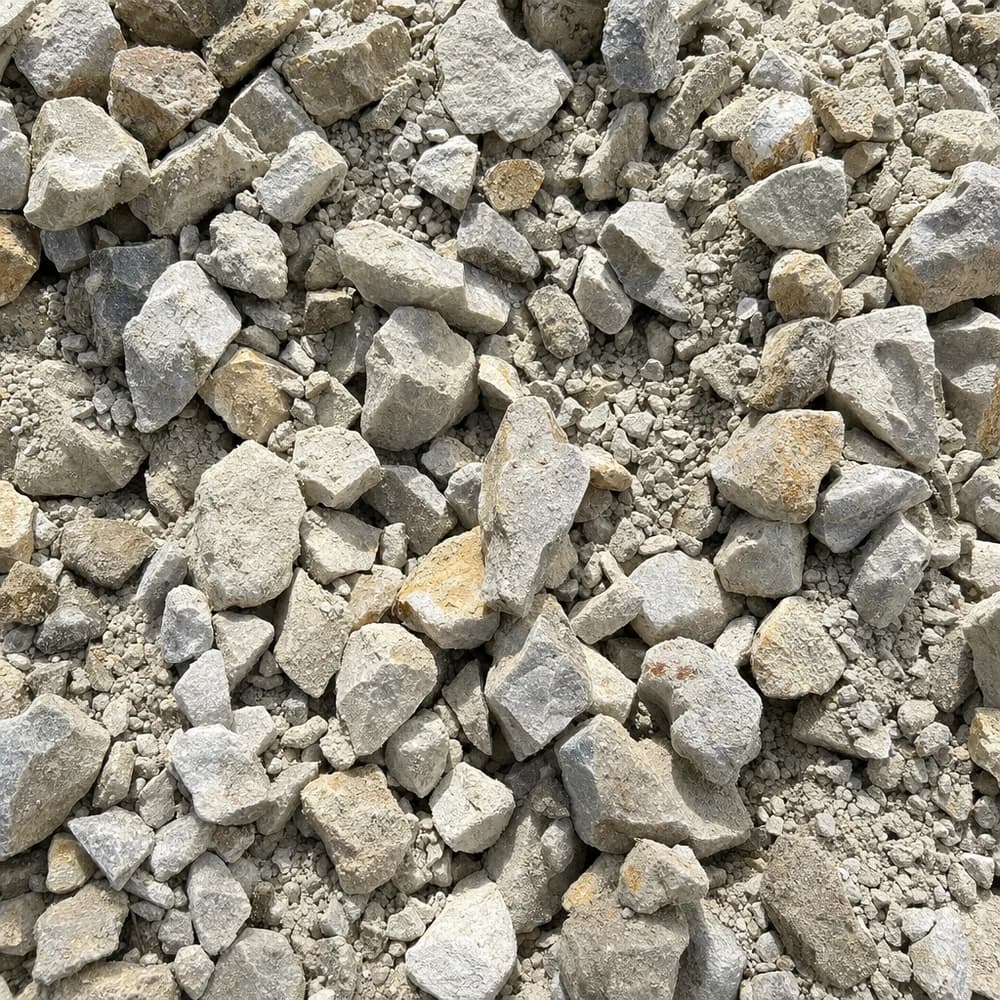
Limerock lands at roughly 3,000 lb a yard because its binding fines fill the voids between the larger pieces, which is the same property that lets it lock up under a plate. Clean washed stone leaves those voids open and comes in lighter, and washed stone for drainage is sized on its own page. Both figures are approximate and both drift with how wet the material is, but the volume you ordered has not moved.
When the tonnage looks right, open Limerock Base to set a quantity and a delivery date, and leave the driver firm ground he can back onto and a dump spot clear of septic lines and low branches, which is what how delivery is arranged covers.
Common questions
The parking area runs beside the drive and then turns in behind the shed. Can the tool add both?
Yes. Choose Multiple areas, enter the strip beside the drive as one rectangle and the piece behind the shed as another, and stop the first where the second starts so the corner is not counted twice. Up to five pieces total in one pass, all at the same depth.
A concrete ribbon curb is going in along the lane. Does that strip belong in the width?
Only if base goes under it. Where the curb sits on its own footing, measure to the inside face. Where the base runs beneath it and the curb is set on top afterwards, measure to the outside line, because you are buying rock for that strip too.
I want limerock underneath and something that does not track into the house on top. Is that two runs of this page?
Two runs, yes, and two lines on the order. Calculate the compacted limerock at your chosen thickness first, then run the same footprint again at 2 inches with the topping material selected. The weights differ, so the tonnages will not be proportional to the depths.
The turn-in from the road fans out and has no straight edge. What do I enter?
Box it. Enter the smallest rectangle that covers the fan, or split it into two rectangles that step out to follow the shape. Over-covering a flare by a few square feet costs a wheelbarrow load, while under-covering it leaves the softest, most-used piece of the whole job short.
The drive has held up except for two soft ruts after the wet season. What depth do I use for a repair?
Measure the ruts rather than the drive. Take the depth of the hollow at its worst point and at its shallow end, enter the average, and enter only the footprint of the patched area under Multiple areas. Rake the old surface up before the new material goes in so the two layers knit instead of sitting in a skin.
Related calculators
Thirty tons. Zero delivery fees.
Road base priced per ton, hauled free, at lane quantities where hauling usually costs the most.