Rip Rap Calculator for Armoring a Bank Before the Wet Season
Enter your project dimensions
The winter dry stretch is when bank work actually gets done here. Machines can reach the toe, the water is down, and whatever you place has months to settle before the first afternoon storms of late May and the hurricane season that follows through November. That window is short enough that ordering the wrong tonnage costs you the season, so it is worth being clear about what this rip rap calculator can tell you and what it cannot.
What no tonnage figure knows about a bank in front of a storm
The tool converts a slope-face area and a layer thickness into weight. It has no view of the things that decide whether the stone stays put.
It does not know how steep your bank is. Anything steeper than two to one wants shaping before stone, or engineering rather than extra rock. It does not know where scour has already undercut the toe below the waterline, which is where armor failures start. It does not know that the ground behind the face is loose sand that will wash out from under the rock the first time water gets behind it, which on this coast is the single most common reason a bank of good stone ends up slumped at the bottom. And it does not know that a permitted, engineered project on a highway or a spillway carries its own stone classes and layer depths that override anything on this page.
Use the number as a material order. Use the site walk for everything else.
Why a cubic yard of armor stone lands at 3,100 pounds
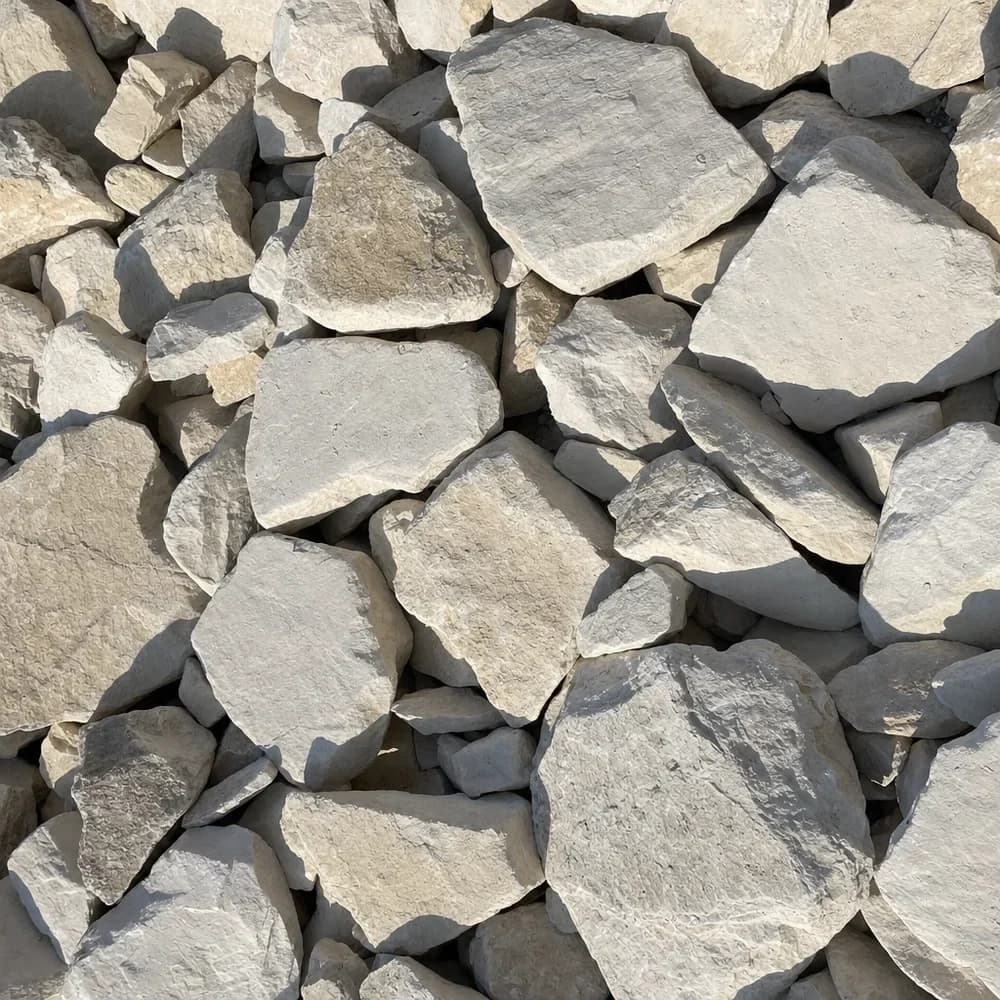
Riprap is the heaviest figure this site publishes. A cubic yard runs about 3,100 lb, which is 1.55 tons, and that comes from stone commonly sized four to twelve inches and up.
Where that weight really shows is coverage. Because armor goes down in layers of a foot or more rather than the two or three inches you would spread of landscape stone, a ton of riprap covers roughly 17 square feet at a 12-inch layer, about 12 at 18 inches and about 9 at 24. Put another way, a 12-inch layer takes about 5.7 tons for every 100 square feet of bank face. Set that against a decorative layer two inches deep, where the same ton reaches well over a hundred square feet, and the reason the delivered pile looks modest right up until you start placing it becomes obvious: the depth, not the stone, is what eats the tonnage.
The arithmetic behind the boxes is unchanged from every other tool here. Slope-face area in square feet, times layer thickness in inches, divided by 12, gives cubic feet. Divided by 27, that gives cubic yards. Multiplied by 1.55, the yards give tons.
Running the rip rap calculator off a tape laid down the face
The measurement that catches people is the area. Do not measure across the level ground from the top of the bank to the waterline. Lay the tape on the bank itself and follow the slope down, then multiply that slope length by the length of shoreline or channel you are armoring. On a bank of any real pitch, the difference between the two is a ton or three.
Then set the thickness. Use a layer one and a half to two times the largest stone dimension, and treat 12 inches as the floor. Four to twelve inch rock generally wants 12 to 18 inches, and larger stone or faster water wants 24. Where you are choosing between sizes, take the larger stone and the thicker layer, since weight is what buys tolerance.
In the tool, Rectangle takes the slope length and the run in feet, Circle takes one diameter for an apron or a round outfall pool, and Multiple areas adds up to five pieces for a bank that changes pitch along its length. Depth is in inches from a quarter inch to 24, so an 18-inch layer is entered as 18. The material select sets the weight for the tons line, and a checkbox adds an optional 5 percent for compaction and spillage. Cubic yards, tons and cubic feet come back together, and the figure can be emailed to you.
Forty feet of canal bank and a culvert apron behind it
Two hypothetical jobs on one property, both worked through.
The bank is 45 feet of canal edge, and the tape laid down the face reads 6.5 feet from the top to below the waterline, so the area is 292.5 square feet. At a 15-inch layer, 292.5 x 15 = 4,387.5, divided by 12 is 365.6 cubic feet, divided by 27 is 13.54 cubic yards. At 1.55 tons a yard that is 21.0 tons, or 22.0 with the 5 percent ticked.
Underneath it goes a bedding layer, and on sand that layer is not optional. Non-woven geotextile is one answer, sourced from a landscape supplier since it is not stocked here. Four inches of #4 Crushed Stone is the other: 292.5 x 4 = 1,170, divided by 12 is 97.5 cubic feet, divided by 27 is 3.61 cubic yards, and at about 2,900 lb a yard, or 1.45 tons, that is 5.2 tons.
The culvert outfall at the back of the property gets an apron. Extending four to six pipe diameters downstream on a 24-inch pipe puts it around 10 feet across, so Circle mode with a 10-foot diameter gives 78.5 square feet. At 18 inches, 78.5 x 18 = 1,413, divided by 12 is 117.8 cubic feet, divided by 27 is 4.36 cubic yards, or 6.8 tons, and 7.1 with the allowance.
Twenty-one tons, five tons and seven tons, on a property where none of the three jobs looks big from the house.
Keeping a ton back for the first storm that moves stone
Round up, and then hold some of it in reserve on site. Tropical rain finds the gaps in a new bank faster than anything else, and the repair you want to be making after the first big storm is filling a thin patch, not booking a second delivery for a quarter ton.
Place the bottom course first and set it below the waterline or below the depth you expect scour to reach, because a toe that is not embedded takes the rest of the bank with it. Before that course goes in below the ordinary high water line of a canal, lake or tidal shoreline, ask your state and local authorities what approval the work needs. Putting rock in and along water is commonly permitted work, what is asked for depends on the waterbody, and nothing on this page replaces that question. Fit the exposed upper stones together rather than tipping them and letting them lie where they land. Then go back and look at it after the water drops: displaced rock at the toe, bare ground showing between stones, fabric visible at the surface. A short walk twice a year catches movement while it is still a wheelbarrow job.
Be honest about which problem you have before you order. Armor stone answers moving water. A slope that is simply wet and seeping wants drain rock for a wet slope, and a dry creek bed that only carries runoff after a storm is decorative work sized on the river rock calculator. Where the tonnage here is genuinely the answer, open RipRap to choose a quantity and a date, check how delivery is arranged for the access the truck needs, and send us the bank measurements if you are not sure the slope is one you should be armoring yourself.
Common questions
Do I buy the armor stone and the bedding rock as two separate orders?
Two lines, usually. The armor stone itself is the RipRap product page, sized by the figure this calculator returns. The layer underneath is #4 Crushed Stone if you are bedding with rock rather than geotextile, and that is a separate calculation at three to four inches over the same face area. Order both together so the bedding is on site first.
Where should twenty tons of armor stone be dropped?
On firm, level ground the truck can reach and turn on, as close to the top of the bank as is safe, with room to work a machine around the pile. The last twenty feet to a pond or canal edge is usually soft, and a loaded truck that sinks there is a bigger problem than a longer carry. Moving this material twice costs more than any other decision on the job, so walk the access route before you book.
Why does the result show cubic yards and tons for the same pile?
Because the bank is specified by volume and the stone is sold by weight. Cubic yards describe the space your layer fills; tons describe what that space weighs at about 3,100 lb a yard. One ton of riprap is roughly two thirds of a cubic yard, which is the figure to keep in mind when a pile looks too small for the bank it has to cover.
Do I enter the loose depth or the settled depth?
The placed layer thickness, which for armor stone is effectively the finished depth. Riprap is set rather than compacted, so it does not lose height to a roller the way a graded base does. What it does lose is position, which is what the toe embedment and the interlocking of the upper course are for.
How do I size a round scour pool or a circular apron?
Use Circle mode and enter the diameter in feet, then apply your full layer thickness the same way you would on a bank. For an outfall, work the diameter out from the pipe: four to six pipe diameters of protection downstream is the usual span, so a 24-inch pipe gives you something around ten feet across.
Related calculators
Banks don't armor themselves.
RipRap by the ton with free delivery, plus the #4 bedding stone to go under it.