River Rock Calculator: Sizing a Bed That Storms Keep Rearranging
Enter your project dimensions
Most people open this river rock calculator standing over the same strip of ground: the band along the foundation where a summer of afternoon downpours has cut a channel through the sand and carried last year's stone out into the grass. Rock beds on a flat sandy lot are doing work as well as sitting still. They take roof runoff, splash off a screen enclosure and the water that collects at the low end of the property, and the depth you type is what decides whether the bed is still where you put it after the next wet season.
Layer depths for a drip strip, a border and a creek run
Rounded stone has to sit deep enough to hide what is under it. The working rule on this site is a layer close to twice the diameter of the stone, which is why the coverage a ton buys you drops so sharply as the rock gets bigger.
| What the bed is doing | Stone size | Layer | One ton covers |
|---|---|---|---|
| Drip strip against a wall or slab edge | 3/4 to 1 inch | 2 inches | about 120 sq ft |
| Planting bed, border or splash pad | 1 to 3 inch | 3 inches | about 80 sq ft |
| Dry creek run, heavier decorative work | 2 to 4 inch | 4 to 5 inches | about 53 sq ft |
| Set accent pieces | oversize | single layer | 35 to 50 sq ft |
Go thinner than that and the fabric grins through within a month, usually first at the corner where the downspout lands. A creek run at 4 inches sits between the second and third rows: at that depth a ton of 1 to 3 inch stone reaches roughly 60 square feet.
Beds, splash pads and a creek run through the river rock calculator
Three shape modes cover almost every bed on a residential lot. Rectangle asks for a length and a width in feet. Circle asks for one diameter in feet, which is how a ring around a palm or a fire pit surround goes in. Multiple areas takes as many as five separate pieces and totals them, so a border, a mow strip and four downspout pads are one calculation rather than four.
The depth field is in inches and accepts anything from a quarter inch to 24. One depth applies to the whole run, so areas that want different layers have to go through separately. The material line sets the weight behind the tons figure, and a checkbox adds an optional 5 percent for compaction and spillage. The results panel gives cubic yards, tons and cubic feet together, and there is a button to have the figure emailed to you.
Thirty-four feet along the wall, then the run behind the cage
Hypothetical numbers on a hypothetical lot, worked longhand so you can follow them.
The strip along the front of the house runs 34 feet by 2.5 feet, which is 85 square feet. Four splash pads under the downspouts are 3 by 2.5 feet apiece, another 30 square feet. Both want 3 inches of 1 to 3 inch stone, so they go in as one multiple-areas run at 115 square feet. 115 x 3 = 345, divided by 12 is 28.75 cubic feet, divided by 27 gives 1.07 cubic yards. Rounded stone is published here at about 2,700 lb a cubic yard, or 1.35 tons, so that is 1.44 tons. Tick the 5 percent and it reads 1.12 yards and 1.51 tons.
The creek run behind the pool cage is a second entry because it wants a deeper layer: 22 feet long, averaging 4 feet wide, at 4 inches. 22 x 4 = 88 square feet. 88 x 4 = 352, divided by 12 is 29.33 cubic feet, divided by 27 is 1.09 cubic yards, or 1.47 tons. With the allowance, 1.14 yards and 1.54 tons.
Two entries, a shade under three tons between them, or just over with the 5 percent ticked, and the deeper one is the smaller bed.
What 2,700 pounds a yard does to the heap on your drive
Volume and weight are two readings of one pile. Cubic feet is the raw figure: footprint in square feet times depth in inches, divided by 12. Cubic yards divides that by 27, a yard being a block three feet on every side. Tons applies the published weight for whatever you picked on the material line.
At 1.35 tons to the yard, a delivered ton of rounded stone is about three quarters of a cubic yard. That is worth knowing before the truck leaves, because a ton looks like a disappointing heap next to a bed you have been picturing for two weeks. If the bed comes up bare after spreading, the depth was short, not the load. It is also why the same footprint and depth in a graded crushed stone comes back heavier: that material is published at roughly 2,800 lb a yard, and screenings heavier again.
Ordering past the number on ground that moves
Stone migrates here in a way it does not on firmer ground. Heavy rain rolls the smaller sizes toward the low end of a bed, and bare sand lets the bottom layer press down into the subgrade over a season or two. The 5 percent option covers spillage and what the wheelbarrow route loses. It does not cover a bed that is going to need feeding again.
So order to the top of your figure rather than the bottom, and put the surplus along the front edge and at the downspout corners, which are the two places that thin first. Non-woven fabric under the bed keeps the stone from disappearing into sand, though where water is genuinely moving through the stone the fabric belongs wrapped around it instead of laid flat beneath it. Hose the bed down once it is spread, since transport dust dulls the color until it is rinsed off.
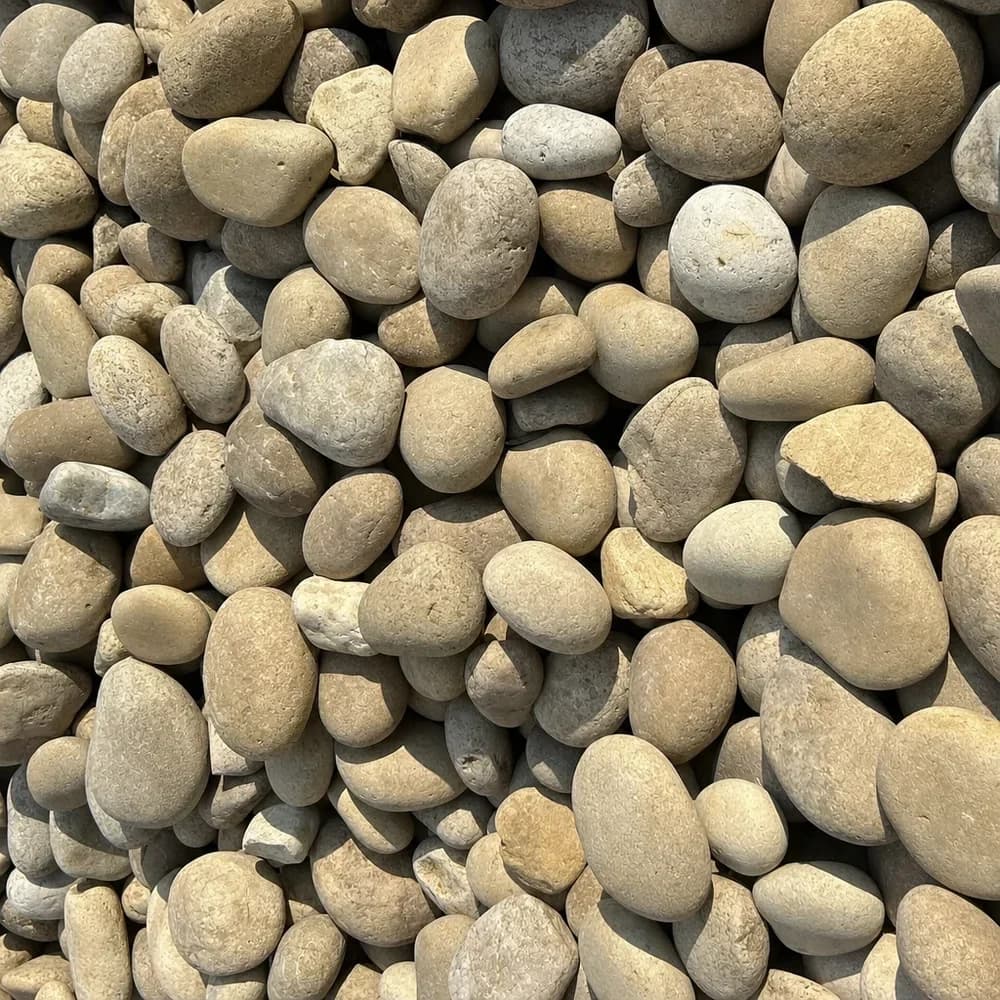
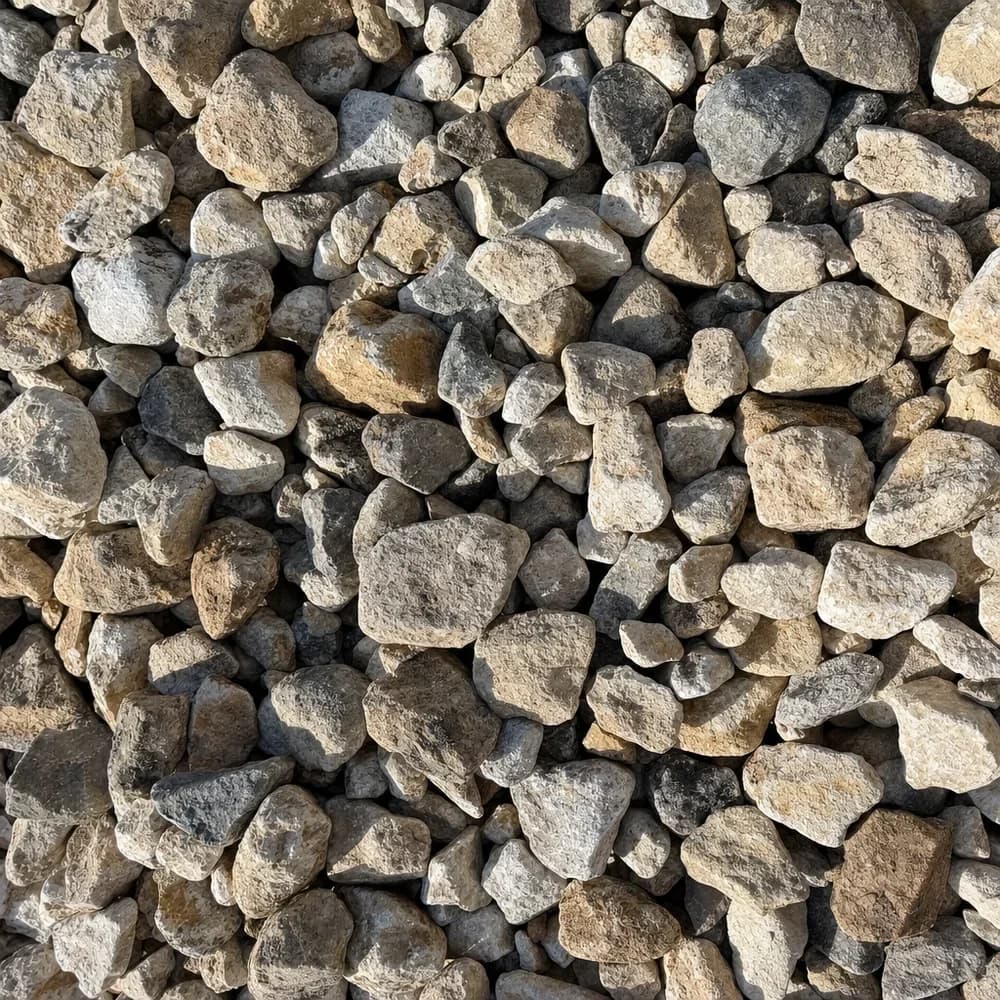
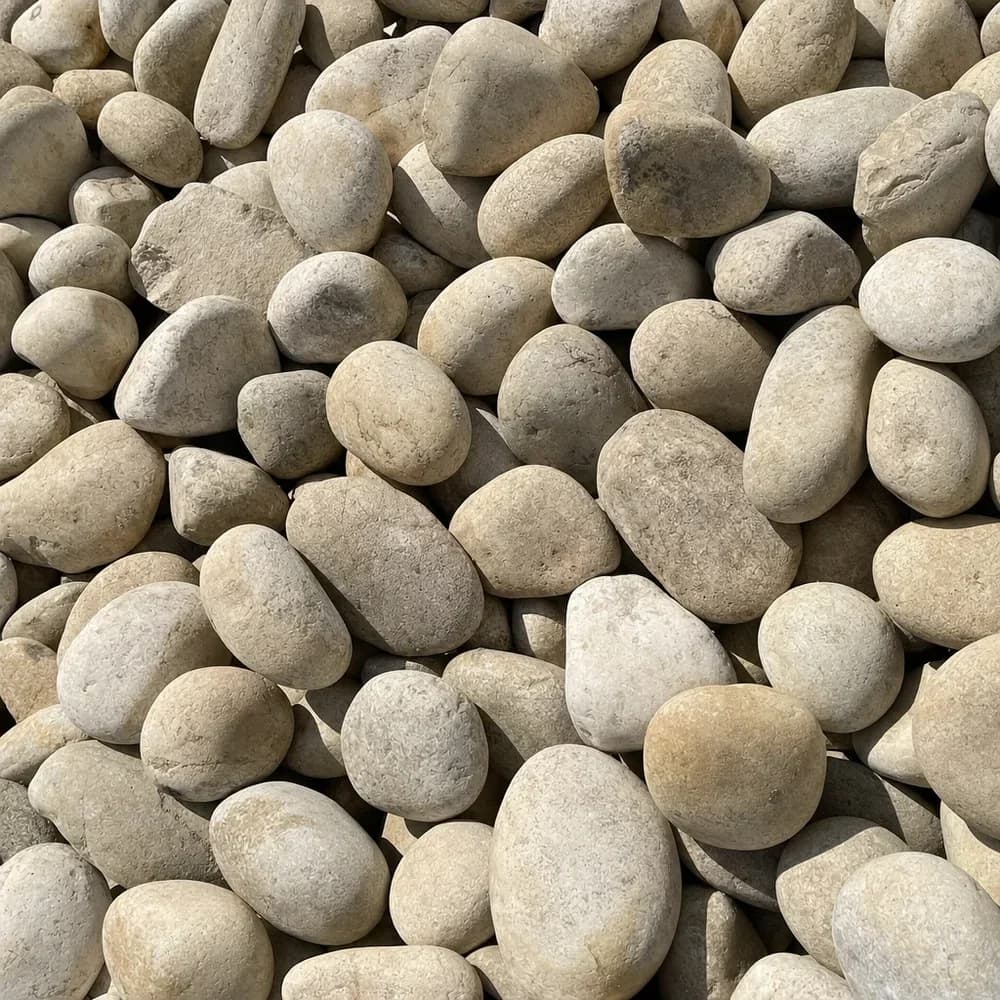
Three rounded listings sit behind the material line: River Rock for beds and splash work, Large River Rock for creek runs and bank edges, and Drain Rock where the stone is there to pass water. Take your tonnage to whichever of the three matches the job, pick a quantity and a delivery date, and leave the truck a firm spot within wheelbarrow distance of the bed. If you are not sure which size suits the bed, send a photo and the measurements through the contact page first.
Common questions
Nothing about my bed changed except the material line, and the tonnage moved. Is that right?
Yes. The yardage is fixed by your footprint and depth, and only the weight behind it changes. Rounded river rock is published here at about 2,700 lb a cubic yard, crushed stone nearer 2,800 and screenings about 2,900, so the same hole bills differently depending on what fills it. The numbered grades are sized as graded crushed stone on their own page. Order against the figure for the material actually going in the bed.
Is the 5 percent enough for a bed sitting where the roof dumps water?
It covers the handling losses, not the stone that walks downhill over a wet season. On a bed taking roof runoff, tick the box and then round the tonnage up as well, so there is something left to feed the low corner in October.
Half the bed is on the bank going down to the retention pond. Does the fall change what I type?
It does. You are covering the face of the bank, not its shadow on a plan, so run the tape down the slope itself. A stretch that reads 18 feet across level ground can be 20 or more down the face, and that gap is real stone. Where the bank is eroding rather than being dressed, that is bank and shoreline protection instead.
The border goes along the front of the house and then down the side. Can that be one calculation?
Yes, as long as both legs get the same depth. Choose Multiple areas, enter the front as one rectangle and the side as another, and stop the first where the second begins so the corner is not counted twice.
Where does the bed stop against a paver edge?
At the inside faces, since that is the only space the stone fills. The exception is an edge that has not gone in yet and will be bedded on the same material, in which case take your figures out to the outer line.
Related calculators
Rock beds are a one-time buy.
River rock, large river rock and drain rock by the ton, free delivery included.